I spent last week in the wonderful company of over a dozen fellow printers, as the “Printers’ Gathering” – which I first dreamt up two years ago when elected as a member of the Executive Committee of the British Printing Society – finally came to fruition. A major theme of the discussions we had centered around the question of preservation of equipment, type, and knowledge. I think many of us shared the sense that as letterpress printers in this era we are as much curators as we are craftspeople or artists. I left feeling simultaneously energised to return to my own pressroom and a little overwhelmed by the scale of the challenge.
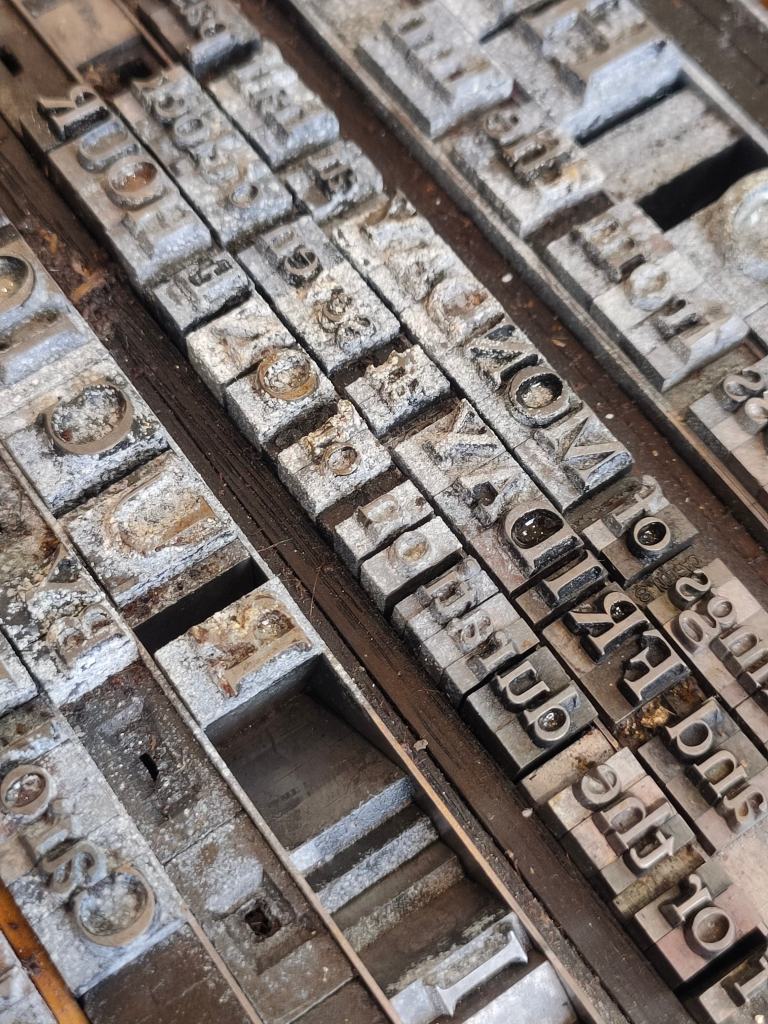
The first thing I saw on the side of my worktable was a galley (a big metal tray for holding type) which I had retrieved from my shed last week. Two years ago I bought two massive cabinets full of type from a retired printer in a nearby village. Along with the (relatively) well-organised typecases I also inherited all of the jobs which he had never dissed (“redistributed”) from his time as a jobbing printer. This particular galley was full of Stephenson & Blake’s Caslon Old Face in large sizes, 24 up to 60pt.
As you can see from the picture above, this type had also suffered not only from two years in my damp shed but also at least a decade, I believe, in its’ previous owners damp garage. If you aren’t a printer and are reading this, the gritty white stuff covering half of the type in the picture is lead oxide. This is unfortunate stuff for a couple of reasons. Metal type is made from a lead alloy (lead, antimony, and tin in varying proportions depending upon the casting machine used to make it), which is actually perfectly safe to handle – I just tell students or visitors to make sure they don’t eat any type. What isn’t so safe is lead oxide, which is poisonous. More distressingly, even if you do manage to clean it off, it has a tendency to ‘pit’ the type, which if on the surface of the letter will of course affect printing. I have heard a lot of older printers say that you are better off just throwing out oxidised type.
To some extent I can see their point, and probably will regretfully dispose of some of the worst affected letters from this galley. But the thing is that 60pt Caslon Old Face as cast by Stephenson & Blake does not exactly grow on trees. And here is the crux of some of the anxiety which I think many of us at the Printers’ Gathering shared: a lot of ‘this stuff’, with which we fill our workshops, is vanishingly rare and will never be made again. As far as I know the matrices from which this type was cast have been destroyed, or are buried deep in a basement of the Science Museum.
So, I spent an hour this afternoon doing triage on the first half of the type galley. First I pulled out, wiped off, and dissed all of the pieces of type that were merely dusty or had spiders on them. (Squeamishness is not for the letterpress printer working with old gear). Then I took the ones which were only a little bit blighted and followed a trick shared with me by Graham Moss of the Incline Press (a man of enormous letterpress knowledge and generosity who is sadly no longer with us). This trick is to spray the type with WD40, scrub it with a toothbrush and then rub the excess off. This has successfully restored to ‘reasonable working order’ a good two dozen letters. I then sighed and hid the rest of the galley underneath my workbench to be tackled another day, when I will have to decide which pieces to fully dispose of and which to carefully soak in vinegar and lemon juice, which is theoretically the trick for cleaning off really bad oxidisation.
Having played with dangerous substances for a while I then started to worry about the stability of the 600kg plus of cast iron standing in the middle of my pressroom – but that’s another thing to think about for another post…!


Leave a comment